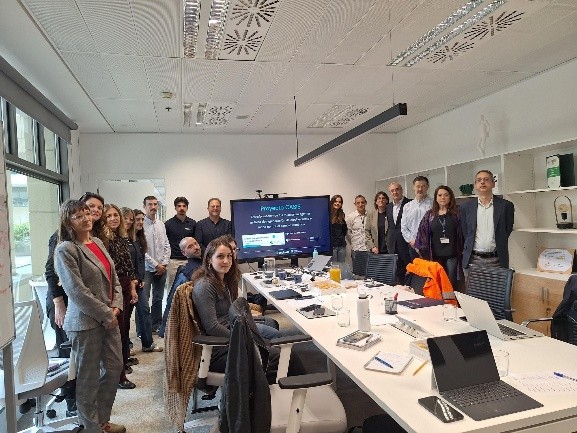
Within the framework of the call for Commercial Projects 2020 of the Ports 4.0 program, one of the most innovative developments has been the creation of 1MillionBot Maritime, an intelligent platform that has revolutionized the interaction between port operators and digital systems. This solution, driven by 1MillionBot in collaboration with the Port of Alicante, has introduced the use of voice commands to automate critical processes in port operations, allowing workers to keep their hands free while interacting with systems such as Poseidon, dedicated to container management.
The project has successfully addressed several of the major challenges of the port logistics sector: the lack of integration between systems, the need to operate machinery more safely, the slowness of manual processes and the difficulty of harnessing real-time data. Thanks to this technology, operators can perform complex tasks without interrupting their physical activity, improving efficiency, safety and agility in the port environment.
Could you briefly describe the project and its main objective?
Of course. The 1MillionBot Maritime project consists of a platform that automates port processes through voice commands. The objective is that operators can interact with the systems without stopping their physical work, keeping their hands free, which improves safety, efficiency and agility. This solution has been implemented not only in container handling, but also in cranes, further facilitating operations without interfering with the physical control of the machinery. We have developed it together with the Port of Alicante, integrating it with tools such as the Poseidon container management system.
What specific problem in the port logistics sector does your project address?
We solve several at once:
- Lack of seamless integration between systems.
- The need for hands-free operation of machinery safely.
- Manual processes that slow down operations.
- Difficulties to analyze and take advantage of real-time data.
In short, we help to digitize processes without complicating the lives of those who work at the dockside.
How did the idea for the project come about?
We detected that voice-driven virtual assistants had great potential for port logistics. We started talking to the Port of Alicante and TMS in 2020, just when the confinement arrived. Since then, we have been modeling a project designed not only for Alicante, but also for other medium-sized ports, where this type of solution can make a big difference.

What were the main challenges you faced during the development of the project?
The main challenge was to integrate our voice solution with existing systems in the ports, such as Poseidon. Another challenge was to design a useful and simple solution for the operators working on a daily basis, making sure it was practical and easy to use in their environment. In addition, we had to adapt to the pandemic situation at the beginning, which involved working remotely and limited testing. Other technical issues we faced included latency and connectivity, which were essential to ensure that communication between the
We also had to deal with ambient noise in the port environment, which made it difficult to understand the voice commands accurately. We also had to deal with ambient noise in the port environment, which made it difficult to accurately understand voice commands, and adapt to the specific needs of dockworkers, who operate in a busy environment and require an intuitive and efficient interface.
What innovative technologies or methodologies did you use?
We work with Artificial Intelligence applied to natural language processing, Machine Learning and Deep Learning. However, at the time we decided not to use generative AI due to reliability and reproducibility issues in the port environment, where accuracy and consistency are crucial for the operation. Our platform is structured in three main components:
- Voice-connected virtual assistants that allow interaction without the need to take your hands away from the machinery.
- An orchestrator that automates flows between different tools, connecting existing systems without the need to replace them.
- A data analysis system that facilitates business decision making, optimizing processes and resources based on the information gathered.
We integrate all of this with existing systems, without the need to replace them.
What concrete results has the project achieved so far?
We have successfully integrated voice commands into real processes at the Port of Alicante, including container movement, access control and operational tasks. We have demonstrated:
- Increased efficiency (no hands and no diversion of attention).
- Increased security.
- Improved ergonomics for operators.
- And most importantly, that this works in real environments, not just on paper.
How has the project improved efficiency or sustainability in the port sector?
Automating by voice improves the pace of work without compromising safety.
- There is no need to take your hands off the steering wheel or the machine.
- No time is wasted switching between devices or screens.
- Repetitive physical micro-movements are avoided.
All of this has a direct impact on efficiency, safety and well-being at work. In addition, by connecting systems, we reduce redundancies and human error.
Do you think the project has potential to be scaled up or replicated in other ports or sectors?
Yes, absolutely. In fact, we have approached it from the beginning as a scalable solution. Many medium or small ports are not able to
afford large technological infrastructures. Our solution is lighter, flexible and adaptable. Language is not a barrier either: we can replicate it in the Spanish-speaking market and easily adapt it to other languages such as English or Portuguese.
What advice would you give to other entrepreneurs or innovators who are considering participating in Ports 4.0?
 Involve from the beginning those who really use the technology. Think not only about innovation, but also about real use. They should also propose modular, scalable solutions with measurable impact. And above all, they should not be afraid to collaborate. Together is how you build solutions that change industries.
How do you think the Ports 4.0 grants have contributed to the success of your project?
Without the support of Ports 4.0, it would have been difficult to validate this solution in an environment such as the Port of Alicante. The program has been a catalyst to move from idea to product, test it, adjust it and launch it to the market. It has allowed us to create alliances, get real feedback and demonstrate the value of applying AI in an environment as complex as a port.