As part of the Ports 4.0 initiative of Puertos del Estado, a project is emerging that is transforming the way intralogistics operations are managed in port and industrial environments. Cleverload®, formerly known as MyPlantManager, is a technological solution that combines hardware and digital intelligence to provide visibility, control and strategic knowledge about critical assets such as cranes and forklifts. A proposal that puts the user at the center and redefines efficiency and safety in the logistics chain.
Could you briefly describe the project and its main objective?
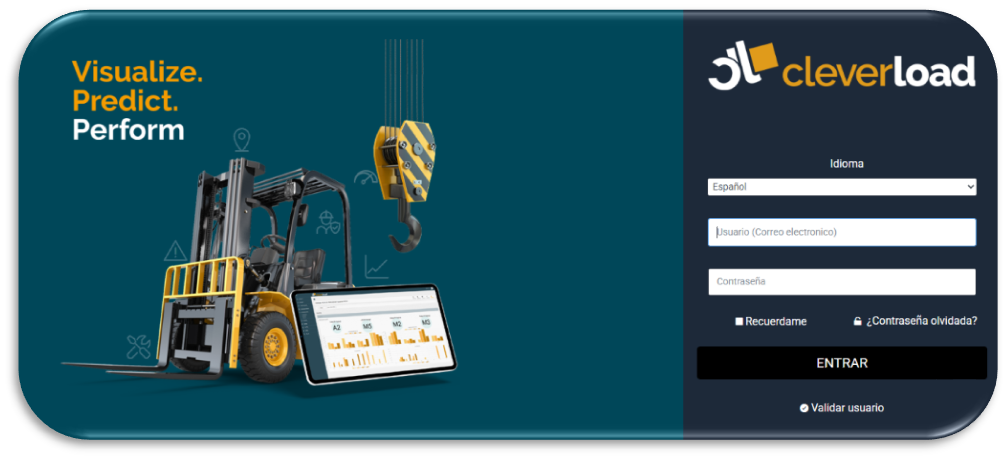
The MPM project (now Cleverload®) is a suite of SW and HW products with protected intellectual property, aimed at addressing the problems of safety and efficiency in the operation and maintenance processes of cranes, forklifts and other assets in the field of lifting and moving loads in industrial plants, commercial ports and marinas and civil works.
What specific problem in the port logistics sector does your project address?
The main problem stems from the lack of visibility in the operations of the intralogistics assets used in the movement of cargo (cranes, forklifts, reachstackers,…), the misnamed (in our opinion) auxiliary assets.
The absence of visibility leads to a series of inefficiencies for the end user in the operation of the assets, in the industrial processes they serve, and in their maintenance, without forgetting the existing compromise at the security level, which is usually attended to a posteriori, once the problem occurs.
How did the idea for the project come about?
The two founding partners come from the lifting and handling industry, and we noticed that digitization was being carried out partially in isolation by machine manufacturers, without taking into account the existing problems for the end user.
We therefore saw an opportunity to develop a suite of HW and SW products (Cleverload) that would put the end user at the center, connected with the rest of the actors, and provide them with high value-added knowledge for their business, based on the collection and processing of data available from different sources (design, operation and maintenance).
Thus the MyPlantManager project and its Cleverload® product suite were born.
What were the main challenges you faced during the development of the project?
The main initial challenge was the financing of the project, since we decided to develop the MPM project internally without relying on external private financing, with our own resources from strategic consultancies that we combined in the first years at IZURUN.
The need to develop a complex HW-SW product with several interconnected modules in a reasonably short period of time led us to start development by outsourcing
all to third parties. However, during development we made the strategic decision to hire qualified personnel at IZURUN to complete its development, which was a challenge in the short term but an undoubted competitive advantage in the long term.
What innovative technologies or methodologies did you use?
Firstly, the daily operating data of the assets are collected with IoT data collectors, with patented technology in the case of cranes, specifically conceived to monitor multi-brand lifting and load moving machinery, in a non-invasive way, integrable with existing electronics with different fieldbuses (CAN-OPEN/J-1939, MODBUS,…).
The various wireless connectivity options (Wi-Fi and 2G/5G) enable real-time cyber-secure bidirectional communication of relevant data between Cleverload® and the monitored assets through the MQTT broker and a graphical user interface (GUI) for intuitive visualization of the processed data, developed with CSS, JavaScript and PHP technologies, customizable for each user and role and with alerts and alarms management.
The architecture of interconnected modular services in the Cleverload® cloud platform guarantees the exploitation of all relevant data other than operational data (such as design theory and maintenance history data) generated by all actors in the value chain (OEMs, maintainers/subcontractors and end customers) in one place during the entire lifecycle and can be integrated with existing third-party applications (ERP, WMS, MES) via REST APIs.
Finally, the processed data is visualized in a digital twin with 3D visualization (developed in Web XR) and converted into valuable field-specific knowledge, thanks to proprietary algorithms resulting from extensive industry experience and the use of different artificial intelligence methods, resulting in value-added functionalities such as Neural Networks for image-based load identification, Machine Learning to design predictive maintenance patterns, and generative AI to improve operational and maintenance procedures.
What concrete results has the project achieved so far?
Over the years, we have developed several Cleverload® modules, such as the Maintenance Platform and asset monitoring through dataloggers (IoT Monitorization), which, in the case of the crane, we have patented.
We have also developed the Simulator service for a project consisting of the development of an offer configurator that visualizes the product in a 3D visualization environment through WebXR technology. We have also used this technology for the visualization of the assets and their relevant data through a digital twin.
At the commercialization level, all these products have reached the market and we have customers in the Ports and Industrial Plants vertical.
We are currently finalizing the development of the last module, the Asset Management module, interconnecting it with the rest of the modules, while we are still immersed in the acquisition of strategic Cleverload® clients.
How has the project improved efficiency or sustainability in the port sector?
The impact of the project on the logistics-port environment has been very relevant, since it is an industrial environment where intralogistics machinery is of key importance for the efficiency of stowage processes and cargo movements, i.e. where the end user plays a key role.
The costs and areas associated with the logistics-port environment are interconnected. The fact that Cleverload® can reduce costs and act in multiple areas such as improving operations, reducing maintenance costs, increasing productivity, without forgetting the essential value related to the safety of people, allows us to increase the efficiency of the intralogistics process by around 20%, according to our estimates after the first projects carried out.
Do you think the project has potential to be scaled up or replicated in other ports or sectors?
Without a doubt. Currently, we are not only present in the logistics-port sector, but we also have clients in the industrial sector, where we see great growth potential in industries whose cargo movement assets are critical in their operating processes, such as forges, steel mills, paper mills and power plants.
In addition, we seek not only to approach the end-user type customer, but we want to establish alliances with maintainers and distributors of intralogistics machinery, such as forklift operators, installation companies and service providers to scale our solution with them.
What advice would you give to other entrepreneurs or innovators who are considering participating in Ports 4.0?
My recommendation to them is not to consider Ports 4.0 as a mere instrument to obtain funding, but rather as an excellent opportunity to collaborate with potential clients who want to test innovative solutions, as well as to obtain support and mentoring to mature any project, whether it is in its initial ideation stage or approaching its commercialization phase.
Co-financing is a means to the above and not an end in itself.
Moreover, in our experience, the logistics-port sector, historically a more conservative sector with respect to digitization, has a very large and varied range of needs and problems to solve, where different technologies and ideas have a place, therefore, I would encourage anyone with innovative solutions to participate.
How do you think the Ports 4.0 grants have contributed to the success of your project?
IZURUN has reached this point thanks to Ports 4.0 and our evolution has been parallel to that of the program.
From the beginning, it was clear to us that it was a program that fit perfectly with our project. I remember coming to the Port Authority of Bilbao several times to inquire about the program, when Bilbao PortLab was not even established yet.
The arrival of Bilbao PortLab and its team was a boost for start-ups like us, and with them, we were able to establish contacts with facilitating agents both in the port of Bilbao and in marinas in the Basque Country and present the pre-commercial project.
Thanks to Ports 4.0 and its support in the pre-commercial project, we were able to develop several Cleverload modules, test our technology and prepare a business model for the commercialization of the products and services.
The project ended successfully, and in fact, at the end of the project, one of our facilitating agents became our first national client contracting several modules (Euskadiko Kirol Portuak).